As a former staff writer for the Daily Breeze and the San Diego Union-Tribune newspapers -- and a contributor to the best-selling Chicken Soup for the Soul books, Diana Chapman has covered the issues peoplefind important. In this blog, she focuses on the community programs and resources that benefit children and teens. Also visit her blog: http://www.secretlifeinmybackyard.blogspot.com. You can email her at hartchap@cox.net @
Wednesday, December 08, 2010
LAPD Deputy Chief Pat Gannon goes after raves so he can protect youth.
ONE 15-YEAR-OLD’S DEATH AND ONE STUDENT’S FALL LATER, LAPD DEPUTY CHIEF PAT GANNON TAKES ON RAVES BECAUSE IT’S YOUR KIDS HE’S CONCERNED ABOUT
By Diana L. Chapman
If he didn’t care about your kids, he wouldn’t have done it.
That’s all I can conclude about Los Angeles Police Deputy Chief Pat Gannon’s recent decision in November to call out the big guns when it came to two rave concerts at the Sports Arena.
While it was controversial to some, I consider his action to haul out an additional 200 plus officers and station them around the event’s parking lot along with drug sniffing dogs nothing less than commendable – especially while we are all waiting for the Los Angeles County Board of Supervisors to provide stiffer safety regulations to help curb disturbances at the events where the mind-altering drug, ecstasy, is commonly used.
But Gannon wasn’t waiting. He didn’t have time too.
As far as he was concerned there was no choice if he wanted to protect youths from further harm. One 15-year-old girl died in June after an overdose complicated by the drug ecstasy taken at a rave and an 18-year-old USC student plunged six floors from a dormitory after partying for two days at another festival on Nov. 1. He had also used ecstasy, Gannon said.
What more do we need to know? Raves – or electronic music festivals as their promoters call them – have been out of control for years and always carried the underlying theme that ecstasy usage was just part of the package. Few understand more about the harmful damages of ecstasy abuse than a deputy chief who has spent hours talking with those impacted by the substance.
“I know they’re wrong,” Gannon said of raves. “It’s been a huge problem for us. We’ve had overloaded trauma rooms. Am I really overly concerned? I think we are sanctioning things at these type of events. I have listened to other parents and spoken to kids who have overdose on ecstasy and they have serious brain injuries.
“To me, there’s just not enough you can do to protect kids.”
Gannon, who heads the southern region of the LAPD, has both the Los Angeles Memorial Coliseum and the Sports Arena under his jurisdiction – where many of the Los Angeles festivals are hosted.
He also readily understood that we – the adults -- missed the boat completely to protect 15-year-old Sasha Rodriquez, a drill team member, who died of an overdose complicated with ecstasy. She had attended 14th annual Electric Daisy Carnival in June – along with 185,000 others at the Coliseum, prompting an outcry – especially from the overwhelmed medical community -- that these festivals need reining in.
Before Sasha’s death, the festivals allowed ages 16 and up, but obviously if one underage teen slips in, there was likely to be countless others. (After the death, the coliseum boosted the age to 18 with an I.D.).
Besides Sasha’s death, about 100 others at the same event – many overdosing ecstasy party goers-- swamped hospital emergency rooms and sixty drug arrests were made, according to news reports.
To further fuel Gannon’s concerns was a lesser known incident. At 6 a.m. Nov. 1 – a Monday morning-- an 18-year-old college student who attended a two-day rave fest that weekend, plunged six floors from a USC dorm – shattering nearly every bone in his body from the waist down. Jackson Roddy, a freshman from Colorado, told paramedics that he had mixed ecstasy, marijuana and alcohol, the deputy chief explained.
Of the phone call made to Roddy’s parents, Gannon said: “I can’t even imagine that.” The deputy chief has shuttled three children to college and off to adulthood. One is accountant, another a police officer and his daughter, the youngest, is a second grade teacher.
To me, as a person who only gets to read about the unnecessary injuries that have gone on at the festivals for years, they are just another Titanic in waiting. If we don’t take control now, we will have another sinking ship with a lot of drowning children.
It’s taken a lot of mayhem to get us at last to focus on what needs to be done to control these monstrous parties that attract popular hip-hop artists and rap stars. Since Sasha’s death (unfortunately we had to wait for that), the Los Angeles County Board of Supervisors called for the establishment of a task force and will consider imposing tougher safety regulations.
The task force --a mix of police, city and health officials – has turned in its recommendations which urge that the festivals end at 2.a.m and require those of drinking age, 21 and over, to wear wristbands so concession workers know who can legally drink alcohol. In addition, emergency personal are recommended to be on the site.
Gannon’s decision to go after the raves while everyone is waiting around for new safety guidelines to be adopted didn’t sit pretty with Los Angeles Councilman Bernard Parks, the former Los Angeles Police Chief who sits on the coliseum’s board.
Parks considered Gannon’s actions overkill and says the costs belong to the police – and not to promoters, something Gannon does not agree with. Parks also argued that Gannon seems to want to eradicate parking lot drug sales.
“…He should probably call in the Sheriff’s Department, the military, the National Guard, the military if that’s his goal,” Parks said in an article appearing on Los Angeles County board Supervisor Zen Yaroslavsky’s website. “There’s been drug deals at concerts before his birth.”
Wait a second – just because something routinely happens, doesn’t make it right.
That’s exactly what I like about Gannon. He understands that. If he could save a kid, he probably would call out the National Guard, the military and anyone else he needed. To the deputy chief, kids are the star on top of the Christmas tree and deserve the highest priorities in protection -- even young folks who’ve turned 18 – and still might not have the “maturity” to understand what they are getting into.
If the new safety guidelines are approved, the county board will send a letter to rave promoters urging them to follow the newly established precautions.
And I know someone who will keep a watchful eye on them to see if they do, trying to ensure there are no more Sasha or Jackson incidents to come.
Tuesday, December 07, 2010
Veronica Mendoza, along with Port of Los Angeles Charter High School students passes out pumpkin to residents. Medoza, the resident association president, said the produce was appreciated.
HELP THOSE IN NEED AT THE RANCHO SAN PEDRO HOUSING BlOCK THIS CHRISTMAS
By Diana L. Chapman
After living in San Pedro for nearly half my life, I’ve always avoided the Rancho San Pedro affordable housing development on Harbor Avenue because of consistent warnings that drugs and gangs exist and persist there.
Perhaps they do.
But last month I learned – thanks to Port of Los Angeles High School teacher Rachel Brunhke – that there are many more families and individuals who are just like you and I – not involved in crime, not doing drugs, or any type of illegal activities. They are just trying to survive.
My lesson happened right before Thanksgiving, when Brunhke and her students took over produce they had grown themselves at the Los Angeles School District Science Center in San Pedro.
The residents lined up and were so grateful to get a small pumpkin, pomegranates and squash and greeted the students with huge smiles.
Veronica Mendoza who lives there with her family –and is president of the resident’s association, said residents within the development pull together to help those who have even less than they do.
“I have a feeling that our own low income community will begin to be viewed for something other than the fearful gang infested projects,” Mendoza said. “You would be surprised what you can learn if you hang out with the disabled woman in the wheel chair that needs food. Our entire community takes turns assisting her and her mentally disabled, sweet daughter.
“Or you could see when the community pull together to raise rent funding for our neighbor who just lost his job and couldn’t make the rent payment and was about to be evicted.”
Residents in the community can use the following items: jackets and toys for children, floor heaters for seniors, trays of food for seniors with turkeys and tamales being at the top of the most requested food items, Mendoza said. Residents are most concerned about the seniors who remain behind during the holidays while many are gone to visit families.
The residents will put on a pot luck dinner from 2 to 5 p.m. Dec. 17 for seniors, but need donations.
To make any of these offerings, you can email Mendoza at: veronicamendoza1@yahoo.com and arrange to drop them off.
“You see, it’s the little things we received that make our lives more pleasurable,” she added.
Sunday, December 05, 2010
TRYING TO SAVE JOBS USING FEDERAL EDUCATION FUNDS; ANOTHER LETTER FROM LAUSD SUPERINTENDENT RAMON CORTINES
December 01, 2010
To LAUSD Employees:
As we come to the end of this calendar year I would like to remind our employees of how hard it has been for all of us to face our new budget realities. This week, we were required to part ways with a number of our longtime and faithful employees, and change the work status of many more.
This was not an easy task nor was it one that we embraced. These tough decisions are impacting our entire LAUSD family including students and parents. As difficult as they are, these were decisions we had to make and act upon.
I know that many of you wanted me to use our one-time Federal Education Jobs Bill funds to prevent some of the job cuts we are currently experiencing; however, in the face of clear indications of a continued bleak budget picture, the use of these funds in the current year would have been grossly irresponsible. We are attempting to bring stability during these turbulent times. If we don’t use these dollars in 2011-2012 to preserve jobs, then our challenge becomes worse, rather than better.
Given that scenario I would like to remind you of the 38,000 certificated and 28,000 classified employees who continue to make a daily contribution to ensure that we continue to provide the best education possible for our more than 607,000 students. I am grateful for the work that you do every day.
Next year will not be any easier. The reality is that 2011-2012 will be an even more difficult year. In an effort to address this situation I have already planned to use the Federal Education Jobs Bill funds, $103 million, to save more than 2,000 jobs beginning next July.
I ask that you stay close as a school community during this season and stay focused on our mission of preparing our students to be college prepared and career ready.
Sincerely,
Ramon C. Cortines
Tuesday, November 30, 2010
LAUSD FINANCIAL FUTURE FAIRLY GRIM; SUPERINTENDENT RELEASES LETTER THAT DOESN'T PAINT A PRETTY PICTURE
Dear Readers:
Los Angeles Unified School Superintendent sent this letter out to his staff. I decided it was just best to print all of it. If you have any comments, please email me at hartchap@cox.net. Sorry, but it doesn't seem like anything is getting better any time soon. This means we all must think out of the box on how to educate our students with -- a lot less. Diana
November 18, 2010
To All Employees
Re: Budget Realities
As truly harsh as this year has been, we balanced the 2010-2011 budget with negotiated give-backs and agreed-upon lay offs. The reality is that 2011-2012 will be an even more difficult year. I have already planned to use the Federal Education Jobs Bill funds, $103 million, to save more than 2,000 jobs beginning July next year. Here are the budget realities we currently face:
·Current Deficit for 2011-2012: Even with the inclusion of this Jobs Bill funding we are still facing an
ongoing deficit of $142 million (based on current projections). To place this in context, this $142 million operating deficit represents a loss of over 3,300 jobs without ongoing furlough days-negotiable with all of our bargaining units-and spending cuts.
·Loss of Federal Stimulus Funding: By the end of this year we will have spent the remaining Federal
Stimulus funds (Title I and IDEA ARRA federal funds) that have been supporting at least 12,000 jobs (3,900 with Individuals with Disabilities Education Act; 3,200 with Title 1; and 5,200 with State Fiscal Stabilization Fund) over the last two years. Almost all of these jobs are at school sites. These funds are gone at the end of this year and there is no replacement funding.
·State’s Budget Crisis: Mid-November, the Legislative Analyst Office (LAO) released a report projecting
a two-year $25 billion cumulative State deficit, including a projected $6 billion deficit for this year. Given the State’s financial situation, it is likely we will face more cuts in addition to those outlined above. We are also more vulnerable to mid-year cuts due to the already announced suspension of Proposition 98.
Our daunting challenge: we have no choice but to continue to reduce ongoing costs to get through this crisis. In the face of clear indications of a continued bleak budget picture, to use the one-time Federal Education Jobs Bill funds in the current year would be grossly irresponsible. We are attempting to bring stability in these turbulent times. If we don’t use these dollars in 2011-2012 to preserve jobs, then our problem becomes worse, not better.
Sincerely,
Ramon C. Cortines
Superintendent
C: Members, Board of Education
Jefferson Crain
Friday, November 26, 2010
Famed Artist Maynard Dixon's Men of the Red Earth, worth an estimated $2 million owned by the Los Angeles Unified School District
Leslie Fischer views some of the collection she's in charge of.
LAUSD curator Leslie Fischer puts together a collection of items used to teach LAUSD students about the history of their predecessors.
Roman coin discovered in the collection along with the Greek Vase below.
LOS ANGELES UNIFIED SITS ON DONATED ART WORKS WORTH MILLIONS; SOME ARE IN SCHOOLS GOING UNNOTICED, OTHERS ARE LOCKED UP IN A CLIMATE CONTROLLED DOWNTOWN SCHOOL POLICE BUILDING;
ONE PERSON’S MISSION : TO MAKE THE COLLECTION WORKABLE FOR EDUCATION AND TO BRING IT TO THE PUBLIC EYE
By Diana L. Chapman
Several years ago, Leslie Fischer was sent downtown Los Angeles to clear out a small, locked space laced in mystery.
The curator opened the door and peered inside, spotting scores of items bundled in newspapers. What she was about to discover shocked her.
As she unfolded the bundles, out popped one antiquity after another, 300 in all;
Relics such as Roman coins, Greek vases, Etruscan figurines, Egyptian scarabs.
Those were just some of the gems. They all belonged to the Los Angeles Unified
School District.
“It was really flooring,” said Fischer of the antiquities find during an interview at
one school that has a vault to secure its paintings. “I wasn’t even aware of the
scope of what they had. The storage was so inappropriate. It was surprising. How
did the district get this and why is it here?”
Fischer – whose very part-time LAUSD curator job always hangs by a thread
in these severe economic times – is the only person in the entire district who
holds the golden key to Los Angeles Unified’s 100,000 piece art and artifact
kingdom. She’s on a new mission to bring the obscure collection out to the public
eye and to form several educational partnerships.
The collection boasts phenomenal pieces such as oil paintings from famous artist
Maynard Dixon and rare books as the 1602 edition of “Works of Our Ancient and
Learned English Poet, Geoffrey Chaucer.”
In addition, the works include thousands of oil paintings, murals, text book
collections, aged-video equipment, administrative reports, paintings from the
Depression era, 34,000 black-and-white negatives and scores of other items that
reflect the district’s history.
After the antiquities find, Fischer immediately cataloged the precious pieces. Her
job shape shifts itself every few years depending on the needs of the district -- an
agency that faces a $1.1 billion deficit over the next three years. Although debate has
arisen in the past about selling some of the works, school officials balk at that -- es-
pecially involving the scores of paintings donated by the student body going back
nearly a century ago.
The ownership of those paintings, they said, belong to the student body and
cannot be sold. District owned works, however, can be.
In 2008, the curator, whose now nine-hour a week job is paid through a mix of grants and the district’s art budget, was able to obtain grants to appraise about 60 percent of the most valuable pieces. The estimates ranged anywhere from $9 to $13 million. Remaining pieces have not yet appraised for financial reasons, but are not considered to have as much monetary significance.
LAUSD’s most valuable painting -- Artist Dixon’s Men of the Red Earth– is currently on loan to the Autry National Center -- where it was restored for free as part of the agreement reached with the curator – one of the many partnerships Fischer has forged. The painting -- worth $2 million – is the highest priced treasure in collection and is considered one of the artist’s greatest works, the curator explained.
But other famed artists works landed a home with the district as well, including
Edgar Payne, Dana Bartlett, Orrin White and Maurice Braun – known for their l
andscapes using a style called California Plein-Air.
Calling up their names on the internet shows a fair amount of traffic to sell and buy the artist’s works . While many of the paintings remain today up on the walls at school campuses across the district, at least now most have been accounted for due to Fischer’s efforts.
Nine years ago, when there was no curator, no one in the district was overseeing
the massive treasures trove except for in a piecemeal fashion. Many pieces were
scattered across the district, gathering dust in one building or another or remained
up at schools where few knew their stories, their value – or who even the artists were.
What was so unsettling about this was the possibility that many works might get
tossed due to school staff’s lack of knowledge as to the stature of such pieces. In
addition, poor storage meant the art work could be marred or destroyed.
As an advocate of keeping the “historical collection” intact, Fischer’s first job was to
“define the scope,” of what the district had amassed. Once that was done,
school officials wanted the works, a vast amount stored in one building, to be moved
to make way for a new school.
That’s how a large part of the compilation wound up on a climate-controlled floor
of the downtown LAUSD school police building, another one of curator’s suggestions
for security reasons.
While Fischer, a USC fine arts graduate, continues to build partnerships to pay for
costly restoration and to bring much of the unseen works to light through education,
the task is painstakingly arduous, especially with a job that has been whittled down
from 25 hours to nine hours a week.
While some members of the student body desire to keep the works, others wonder why the schools haven’t sold them off.
Often many paintings hang forlornly on school campuses – seeming to go unnoticed.
Few teachers, principals and students are typically aware of their value, who painted them or even the history of how they wound up in the school in the first place.
One principal was surprised when he learned he had a valuable painting at his school.
Another school official thought the paintings were slowly getting damaged on school walls just by the lack of care they receive and that some should be removed to make way for contemporary works.
She’d like, the principal added, something more modern to fit with her current student body.
Ironically, when the artistic gifts – donated by the student body -- started rolling into schools nearly a century ago, district officials – who are meant to educate students – never knew what the reality would mean.
It forced LAUSD to take on another significant post – that of a museum curator and one that’s a complete necessity to prevent the works from being destroyed, trashed or both.
Without Fischer aboard, the 300 antiquities in the closet might have wasted away for many more years -- if they were ever found. That’s what she fears could happen to other treasures within the district’s realm not brought to her attention and suspects some works in the past were possibly tossed.
Therefore, when she receives random calls about pieces from principals or teachers, she gets out her sleuthing skills and visits the site as soon as possible just in case she might add, yet another treasure to this remarkable, little-known collection.
For instance, once a principal called about a pioneer relief on his campus. Soon after Fischer arrived, she discovered the relief was done by prominent English-American sculpture, Bryant Baker, recognized for his works on pioneer women.
The curator’s job then becomes teaching teachers at the school how to integrate the Baker’s work into the state’s standard curriculum, she explained.
Despite Fischer’s momentous work to partner and use the art as part of education, the truth remains that as far as public viewing, little has been done thus far. For one, it would take the work of several more people, she acknowledges.
“It’s baby steps,” she said. “I don’t have a conservation budget and it’s a monumental task.”
Even with Fischer on board, LAUSD school board members – both past and present – seem to have little awareness of what they sit atop of even in these uncertain economic times.
“I’m really uneducated in this area,” said one school official, who asked not to be named.
To spell out just what currently exists just within the antiquities realm, imagine coins with the engraved heads of Roman emperors, some of Caesar Trajan, vases once carried by Etruscan pedestrians or Mesopotamian tablets over 4,000-years-old.
At least 150 coins made of copper, bronze, silver and gold were discovered.
Other finds: 3,000-year-old Egyptian scarab figures along with,2,000-year-old Roman terracotta lamps. While some pieces were worth only $35; others were valued at hundreds more. Some of the Greek vases, for example, range around $35,000 a piece. And at least two gold coins were appraised at $10,000 a piece.
Other famed artist’s within the district’s realm include some Salvador Dali reliefs and a Tom Tyrone Comfort mural. Comfort painted an eight-panel mural at San Pedro High School during the New Deal Era launched by President Franklin Roosevelt to put citizens back to work during the Great Depression. Comfort was one of many artists who did public art work projects under the WPA (Works Project Administration).
Anything done by WPA cannot be sold as it belongs to the federal government, Fischer said.
Much of the distinctive treasure trove began in 1919 when a graduating class in Gardena High School established a tradition to interview local artists around Los Angeles county – most not famous at the time – and purchase a selection as a gift to the school. The students did fundraisers to buy the paintings for their campus and Gardena High School is noted for buying Dixon’s Men of the Red Earth.
“That tradition spread to other campuses that emulated this,” Fischer said. “By the 1940s they actually used the art work in their curriculum. They would go visit living artists. There would be in seminars and they’d study and analyze the available paintings and actually make the purchase,” who added it must have been like heaven to be in that program.
It became a common routine at other high schools especially in the Harbor area, she explained, and didn’t stop until about 1956. After that, a few pieces trickled in. Many LAUSD schools also have famous WPA (Work Projects Administration) murals, including Dana Middle School in San Pedro.
At a time where plant managers, teachers and librarians have been laid off, one wonders why it’s so imperative to keep the collection whole – and not break it up and allow the selling of particular pieces under Fischer’s guidance.
But the LAUSD Arts Education Branch defended keeping the collection intact.
“We are trying to maintain the integrity,” said Luiz Sampaio, a visual art specialist for the district who oversees Fischer. “We are trying to make it accessible while maintaining the physical integrity of the art work. We maintain our commitment. It’s a historical collection.”
Former Los Angeles School Board Member Mike Lansing – who once held Board Member Richard Vladovic’s seat that includes the Harbor Area – said at this point, with the financial disarray of the district, he would want to at least call for a presentation to the school board.
He would not say whether he’d break up the collection.
“I’d at least like to see what exists and have a staff report on what opportunities, if any, are possible,” Lansing said.
After being asked about the collection, LAUSD School Board Member Richard Vladovic says he plans to request that a report be made to the board, but adds that much of the work is owned by the student body, not the district.
However, as for district owned works, he’d like to see what could be sold or what partnerships could be reached.
“I would love to see the items on display in a museum or a traveling show,” Vladovic said. “If we can’t display or show their magnificence properly then we need to find a way to do so or sell them off to those that appreciate and will protect it. This art should be seen and appreciated by as many people as possible.”
Fischer, who has worked diligently to make the collection more accessible, does not want to see it broken up.
“This collection is unique to LAUSD. How do you put a value on that?” Fischer added.
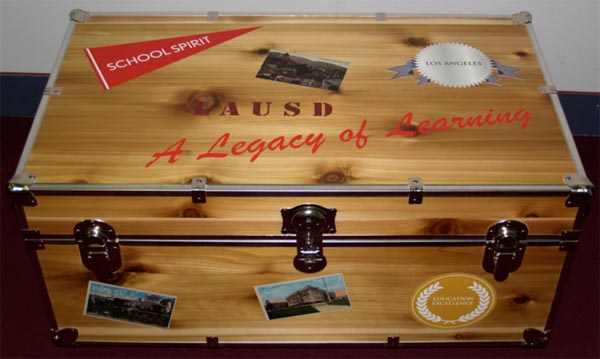
Some of the programs the curator has done, for example, is filling a steamer trunk with district memorabilia that travels from school to school so students can witness what types of clothes, books and other items students used years ago.
But Fischer is most proud of her decision to pull together lessons for students using the antiquities that are not of the highest value. When requested, she packs them up and brings them to schools to show third-through-eighth grade students where they can be hands on with ancient times. College students come to help her teach so the LAUSD students can handle Roman coins, Etruscan safety pens, tablets and vases.
“They tell the most extraordinary story,” the curator marveled.
However, to bring such pieces to schools, Fischer must attend, to keep the pieces secure. Despite limited time to do such work, Fischer has established several partnerships and received several grants.
Included are:
--UCLA and USC graduate students studying the district art works and aiding to conserve them. Restoration costs can be exorbitant, Fischer said.
--The Getty Museum in Malibu, which usually carries the elite of Roman days, worked together with Fischer to select artifacts to use in the classroom. “It’s a good marriage,” Fischer said.
--Hosting programs by either attending events to talk about LAUSD’s rare gems or gives tours to groups, such as the Los Angeles Historical Society.
As for the odd antiquities find, Fischer later learned that most were donated to Venice High School Principal Edward Clark by the now defunct-Classical League of Downtown LA in 1932.
For 45 years, Clark proudly used them to teach his students – before they were later packed up and stuffed into a closest in a school building downtown.
Fortunately, with the arrival of Fischer, the antiquities were resurrected. Otherwise, they might have remained lost forever – stored away in some forgotten closet.
Wednesday, November 24, 2010
HAPPY THANKSGIVING!!! FOUR GOBBLING STORIES FROM THE SEVEN GOLDEN SECRETS TO WRITING CLASS
Dear Readers:
On Wednesday, some of the students in the Seven Golden Secrets to Writing class insisted on writing turkey day stories – some from the point of view of the turkey! For your extreme entertainment, take a break on Thanksgiving and learn what a turkey feels like….
Thanksgiving Afternoon
By Sean Rosenfeld, 8
Once upon a time, it was Thanksgiving afternoon. There was a hunter out and a turkey. The turkey was crossing the road and the hunter was going to a peaceful picnic, but he had a gun.
So anyway, the turkey was crossing the road and the hunter just turned a corner and didn’t see the turkey. But if he did, he would have hunted it. Thankfully, the turkey was able to cross the road. So you know how I told you the hunter had a gun? Well, he really did. The turkey was minding his own business when he ran into the picnic. The hunter said: “Good afternoon.” And then he looked back and thought: “Wait. That was a turkey.”
The turkey was on the ground laughing hysterically. The hunter had a grumpy look on his face. The turkey stopped laughing, looked at the hunter and screamed: “Ahhhhhhhhh!!!”
Pause right there. So you know how I told you it was Thanksgiving and well, the hunter decided he was looking for a turkey. Click, click, sounded the gun.
“Get ready to die,” the hunter told the turkey.
The turkey was so scared he charged at the hunter and the hunter fell off a cliff. Goodbye hunter.
______________________________
The Thanksgiving Ghost
By Jackie Gray, 10
I stared at my insides on the cutting board. How could they kill me for Thanksgiving?!? Why couldn’t they buy some tofu turkey? I sunk into the pot of water where I was being soaked after being salted.
I turned myself into a gas and sunk through the tiny crack between the top and pot. As soon as I located the knobs that control the stove, I got a running start to push the knob off. As I got closer and closer to the knob, I put my wings out in front of me and pushed.
Unfortunately, since I’m a ghost, my wings flew right through the knobs. Then I went racing toward the microwave yelling “ahhhhhh!” I was suddenly in the microwave sitting on top of some leftovers from last night. Corn and steak. Vurrrrummmmm, whirled the microwave.
Oh well, I guess I can never save myself. I poofed out of the kitchen and back to turkey heaven.
Bang. The door closed. The farmer came out with his ax. All of the turkeys ran. I just stood there wondering why all of my family members ran away. My friend Melissa ran to me pulling my wing.
“Come on he will catch you,” she said.
“Catch me doing what? I felt very stupid after I asked that question.
“He will catch you, kill you and eat you for Thanksgiving,” she explained.
“That’s horrible!” I exclaimed. “We should start a union,” I stomped my right set of talons.
“A union against what? The farmer would just shoot us.” She hit my head.
Farmer Trevor walked by and all he heard were two turkeys going: “Gobble. Gobble.”
I marched to the other turkeys.
“Aren’t you tired of that!? I can’t believe that the farmer thinks that he can waltz right in here and snatch a turkey to eat. One of us!”
The other turkeys gobbled in agreement.
“So I propose to run away before he goes on the killing,” I added in my best leader voice.
We marched to the end of the farm only to find a gate.
“Dang-it!” I yelled. We treaded on the perimeter of the gate only to find that we were closed inside the farm.
“Well,” I put my wing on the turkey behind me. “May the best turkey live!”
I ran to hide from Farmer Trevor’s ax, leaving my union behind.
----------------------------
The Cat Who Hated Christmas, But Loves Thanksgiving
By Marina DuVernet, 9
One soggy Christmas, a cat sat inside a nice and hot house under the Christmas tree. That cat’s name was Frisky. Frisky hated Christmas.
First, he hated it because it was freezing. Second, he hated it because he was hungry. Third, he was hungry because his dumb owners always fed him only Uncle Bill’s cookies. Uncle Bill was a horrible chef.
What Frisky does love is Thanksgiving. Frisky can imagine nice, juicy turkey, bright red raspberries and his favorite cold milk. Wait…unless Uncle Bill cooks it. Well, after all, he did wind up cooking Thanksgiving dinner.
I guess Frisky likes Easter.
---------------------------------
Saturday, November 20, 2010
A 9-year-old Spins a Fish Tale at a Seven Golden Secrets to Writing Class
Dear Readers: I will be posting stories by young writers in the Seven Golden Secrets to Writing class given at the Corner Store every Wednesday. If you are interested in having your child, age 6 to 12, enrolled, please email me at: hartchap@cox.net. Students are encouraged to learn to love writing and work on pieces during each session. If you have children of older ages that need help in this craft, please contact me as well. Diana
Mr. Harbor Seal, the Crown and the Goldfish
By Kealan, 9
Once there was a harbor seal and she was looking for a golden seashell.
But before I go into that, even though she’s called Mr. Harbor Seal, she’s actually a girl. So let’s go back to the story.
Mr. Harbor Seal was looking about everywhere for a golden, Pacific seashell. She looked under a rock, in the tide-pools and even in the chilling, blue ocean. But she didn’t find one.
Then one day, she saw something gold. It was so beautiful that she thought it was the shell. So she ran, or should I say flopped, over there. She spotted a crown, but it was no ordinary crown. It was a golden princesses' crown. Mr. Harbor Seal went to show her friend, Goldy.
Goldy was an expert on gold stuff. So he said: “This is a golden crown! Let’s share the crown,” Goldy said.
“Sure,” said Mr. Harbor Seal. So they ended up rich and best friends forever. That’s the happy story.